

Introduction
It’s 2 AM, and you’re staring at the ceiling, that familiar knot tightening in your chest. Everyone around you seems to have a plan, a path, a purpose—while you’re still trying to figure out what you even want for breakfast tomorrow, let alone your life.
Thank you for reading this post, don't forget to subscribe!If this sounds painfully familiar, you’re not alone. Recent studies show that nearly 75% of young adults experience what psychologists call a “quarter-life crisis”—that unsettling feeling of drifting without direction. The question isn’t whether you’ll feel lost; it’s understanding why most people feel lost in life and what you can actually do about it.
Here’s what nobody tells you: feeling lost isn’t a sign that you’re failing. It’s often a sign that you’re outgrowing the life you thought you were supposed to want. And that uncomfortable, disorienting feeling? It’s actually the beginning of something important.
In this post, we’re going to unpack the seven hidden reasons why you feel directionless right now—and more importantly, I’ll show you practical steps to start finding your way again. Not through some magical overnight transformation, but through understanding what’s really happening beneath the surface.
Let’s start by addressing the question you’ve probably been too afraid to ask out loud…
Is It Normal to Feel Lost in Life?
Yes. Absolutely, unequivocally, yes.
If you’re feeling lost in your 20s, you’re experiencing something so common that psychologists have studied it extensively for decades. This isn’t some character flaw or personal failing—it’s a documented developmental stage that most people navigate during young adulthood.
Developmental psychologist Erik Erikson identified this period as “identity versus role confusion,” where you’re actively figuring out who you are separate from who your parents, teachers, or society told you to be. It’s messy, uncomfortable, and completely normal.
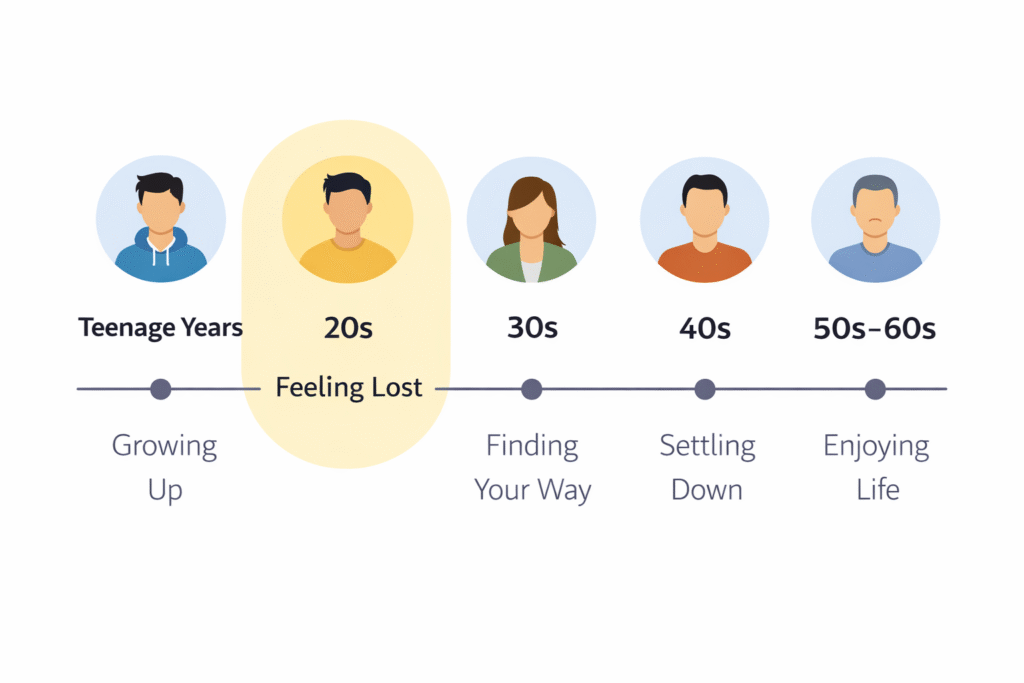
The modern world has made this phase even more complex. You’re dealing with delayed life milestones (getting married later, buying homes later, having kids later), economic uncertainty that previous generations didn’t face, and the constant comparison trap of social media. Your parents had a more prescribed path—not necessarily better, just different.
So when you’re lying awake wondering if something’s wrong with you, the answer is no. You’re right on track, even when it feels like you’re completely off course.
What Age Do Most People Feel Lost?
The peak years for feeling directionless typically hit between 22 and 28 years old.
Why this specific window? It’s the transition period after the structure of education ends and before adult life fully solidifies. You’ve left behind the clear milestones of school (freshman year, graduation, etc.) but haven’t yet established new ones in your career, relationships, or personal identity.
This is when the quarter-life crisis symptoms tend to emerge most intensely. You might feel:
- Restless despite having “good” circumstances
- Confused about career direction even after getting a degree
- Disconnected from friends you’ve known for years
- Anxious about being “behind” some invisible timeline
- Uncertain about your values, beliefs, or what you actually want
Research shows this period can last anywhere from a few months to several years. The duration matters less than how you navigate it—which is exactly what we’re going to address.
But first, you need to understand what’s actually causing these feelings.
The 7 Hidden Reasons Why You Feel Directionless
Understanding why most people feel lost in life starts with recognizing that these feelings don’t appear in a vacuum. They’re the result of specific, identifiable factors that converge during your 20s. Let’s break them down.
These seven reasons are interconnected—you’ll probably see yourself in multiple categories. That’s normal. As you read, pay attention to which ones resonate most deeply. That’s where your path forward begins.
Reason #1: The Paradox of Endless Choice
You have more options than any generation in human history, and it’s paralyzing you.
Psychologist Barry Schwartz calls this the “Paradox of Choice”—the phenomenon where having too many options doesn’t increase freedom, it increases anxiety. When you could theoretically do anything, be anything, live anywhere, choosing becomes terrifying because every choice feels like it eliminates infinite other possibilities.
Think about it: Your grandparents probably had 5-10 realistic career paths to choose from. You have hundreds, many of which didn’t exist five years ago. They had maybe 2-3 places they could realistically live. You could work remotely from 50 different countries.
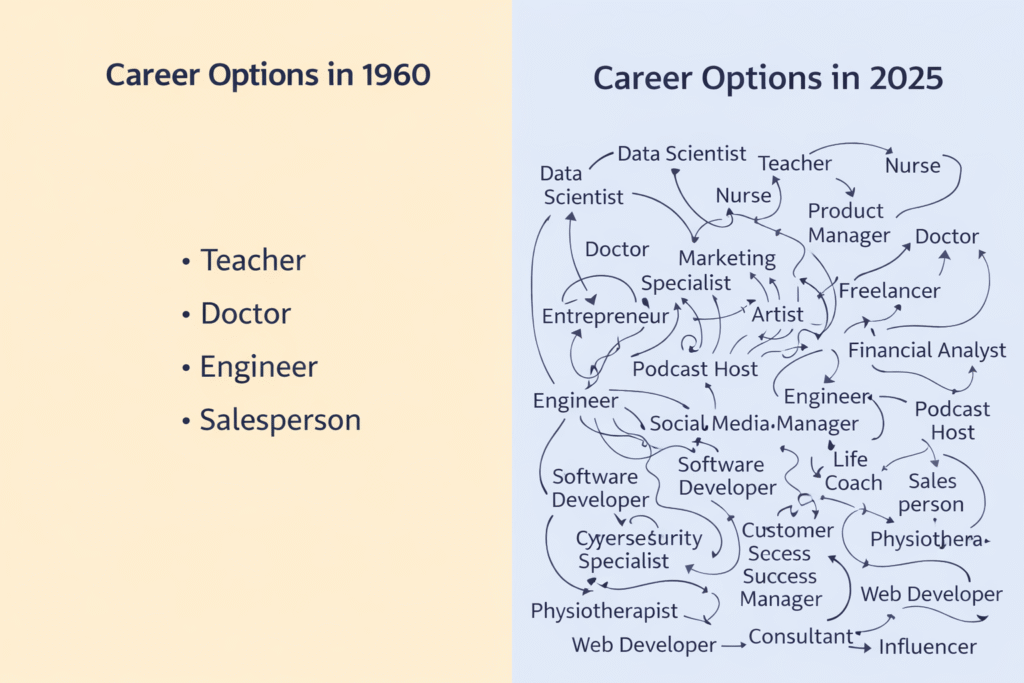
This abundance creates what researchers call “decision paralysis.” You become so overwhelmed by evaluating options that you end up choosing nothing at all. Or worse, you make a choice but constantly second-guess it, wondering if one of those other paths would have been better.
Why Your Parents Didn’t Feel This Way
Your parents operated in a different system entirely. The path was more prescribed: finish school, get a stable job at a company, stay there for 30 years, retire with a pension.
That system had its own problems—lack of flexibility, limited opportunities for women and minorities, less room for individual expression. But it did provide something you’re desperately searching for: clarity. The guardrails were frustrating, but they eliminated the anxiety of infinite choice.
You don’t have those guardrails anymore. That’s simultaneously liberating and terrifying.
The FOMO Factor
Every choice you make feels like it’s closing doors permanently, which triggers intense fear of missing out. If you commit to becoming a teacher, you’re saying no to being a software engineer. If you move to Austin, you’re saying no to New York, Los Angeles, and 500 other cities.
Social media amplifies this exponentially. You see your college roommate thriving as a digital nomad in Bali, your high school friend crushing it in corporate law, and your cousin building a startup—all while you’re trying to figure out if you even like your current job.
Each scroll reinforces the feeling that you’ve made the wrong choice, even if you objectively haven’t.
[CALLOUT BOX:] “The enemy of knowing what you want is thinking you can have everything. Sometimes the path forward requires accepting what you’re willing to say no to.”
Actionable Tip – The 3-Option Rule:
When facing a major decision, force yourself to narrow it down to just three carefully chosen options. Research each thoroughly, then choose. Having exactly three options is enough to feel like you’ve explored possibilities without triggering paralysis. More than three? You’ll spin in circles. Fewer than three? You’ll feel trapped.
But here’s the truth that nobody wants to hear: no choice is permanent, and there is no “perfect” path. There are only different paths with different trade-offs.
The goal isn’t to make the objectively “best” choice. It’s to make a choice, commit to it fully, and make it work. Direction comes from movement, not from thinking.
And speaking of thinking—your brain is probably doing too much of it because of what you’re consuming every single day…
Reason #2: You’re Comparing Your Chapter 3 to Everyone Else’s Highlight Reel
Social media has fundamentally broken your ability to assess your own progress accurately.
You’re scrolling through Instagram and seeing your former classmate’s promotion, your friend’s engagement, someone’s “dream apartment,” another person’s exotic vacation. Your brain unconsciously processes this as: “Everyone else has it figured out. What’s wrong with me?”
Here’s what you’re missing: you’re comparing your full reality—the boring Tuesday, the self-doubt, the messy apartment, the confusion—to everyone else’s carefully curated highlight reel.
Nobody posts about crying in their car before work. Nobody shares the rejection emails, the relationship fights, or the existential dread at 3 AM. You only see the victories, the milestones, the moments worth performing for an audience.
The Instagram Success Illusion
Research from the American Psychological Association shows that people who spend more than two hours daily on social media are significantly more likely to report feeling isolated, anxious, and directionless—precisely because of upward social comparison.
When you see 50 people seemingly thriving, your brain doesn’t process that as “50 individual people having one good moment.” It processes it as “50 people who are all doing better than me across their entire lives.”
This creates what psychologists call the “should” trap. You develop an internal narrative: “I should be further along by now. I should have my career figured out. I should be in a relationship. I should be making more money.”
But these “shoulds” aren’t based on your actual values or circumstances. They’re based on what you’ve absorbed from watching other people’s performances online.
The result? You feel like you’re constantly failing at a game you never agreed to play.
Breaking Free from Comparison
Here’s the hard truth: you cannot consume other people’s highlight reels all day and expect to feel good about your own life. It’s psychologically impossible.
If you’re serious about feeling less lost, you need to ruthlessly curate what enters your mind:
Immediate actions:
- Unfollow or mute anyone who makes you feel inadequate (yes, even friends)
- Turn off Instagram/TikTok for 7 days and notice what changes
- Follow accounts focused on process, not outcomes—artists showing their failures, writers sharing rejections, entrepreneurs documenting the grind
- Set app timers that actually force you off after 20 minutes
Longer-term shift:
- Start measuring your progress against your past self, not against others
- Keep a “wins journal” where you note small victories weekly
- Practice gratitude for what you have instead of fixating on what you lack
The comparison trap is especially dangerous because it prevents you from seeing the real issue: you’re measuring yourself against someone else’s definition of success…
Reason #3: Society Sold You a Broken Success Script
You were handed a blueprint for life that no longer works—and you’re blaming yourself for not making it work.
The script went like this: Get good grades → Get into a good college → Get a good degree → Get a good job → Climb the ladder → Buy a house → Get married → Have kids → Retire comfortably.
This linear path promised security, fulfillment, and happiness. Except for most people reading this, that promise was a lie.
The economic realities have changed drastically. College costs 200% more than it did for your parents while wages have barely moved. The “good job” your degree promised might not exist, or it pays half what it should while demanding twice the credentials. The “starter home” costs $400,000. The “stable career” disappeared with the rise of layoffs, contract work, and the gig economy.
You followed the rules, and the rules didn’t deliver. So now you’re lost, wondering what you did wrong. The answer is: nothing. The system changed underneath you.
The Education-to-Career Pipeline Myth
Let’s talk about the elephant in the room: college doesn’t guarantee career clarity anymore, if it ever really did.
You were told that getting a degree would open doors and provide direction. For some people, it does. For most, it creates a different problem: you spent four years and accumulated $30,000-$100,000 in debt studying something that either doesn’t translate to jobs or translates to jobs you realize you don’t actually want.
Meanwhile, entire industries that are now massive—social media management, UX design, podcast production, AI prompt engineering—didn’t exist when you were choosing your major. The career you might actually love probably wasn’t even an option on the university course catalog.
The education system is designed to create workers for an economy that no longer exists. You’re not failing the system; the system is failing you.
Redefining Success on Your Own Terms
Here’s the liberating truth: you get to decide what success means for you.
Not your parents’ version. Not society’s version. Not what looks impressive on LinkedIn. Your version.
This requires asking yourself hard questions:
- What do I actually value? (Not what should I value—what do I value?)
- What does a fulfilling life look like for me specifically?
- Am I chasing goals because I want them, or because I think I’m supposed to want them?
- What would I do if I knew nobody was watching or judging?
[CALLOUT BOX – Personal Success Audit:] Take 15 minutes and write down: 1. Three things that make you feel most alive 2. Three things you do purely for external validation 3. If money weren’t a factor, how would you spend your time? 4. What does “enough” look like for you? (Enough money, success, achievement)
For some people, success is climbing a corporate ladder. For others, it’s having flexibility and freedom. For others still, it’s creative expression, helping people, or building something with their hands.
None of these is better or worse. They’re just different.
The feeling of being lost often comes from chasing someone else’s definition of success while ignoring your own inner compass. But to follow that compass, you first need to understand what’s happening inside you developmentally…
Reason #4: You’re in an Identity Transition Period
Your brain is literally rewiring itself, and that process feels like falling apart.
Neuroscience research shows that your prefrontal cortex—the part of your brain responsible for decision-making, planning, and identity—doesn’t fully develop until your mid-to-late 20s. You’re not “behind” on figuring out your life. Your brain is still building the infrastructure to do so.
Psychologist Jeffrey Arnett identified this phase as “emerging adulthood,” a distinct developmental stage between adolescence and full adulthood. It’s characterized by five features:
- Identity exploration – actively trying on different versions of yourself
- Instability – frequent changes in relationships, jobs, and living situations
- Self-focus – less obligation to others, more freedom to explore
- Feeling in-between – not quite adolescent, not quite “adult”
- Possibilities – the sense that anything could happen
Sound familiar? This isn’t dysfunction. This is the developmental stage working exactly as it should.
The discomfort you’re feeling isn’t a bug—it’s a feature. You’re supposed to be questioning, exploring, and outgrowing old identities. The problem is that nobody told you this would feel so destabilizing.
Signs You’re Experiencing a Quarter-Life Crisis
Not sure if what you’re experiencing is normal identity development or something more? Here are the hallmark signs of a quarter-life crisis:
Emotional signs:
- Persistent restlessness despite having objectively “good” circumstances
- Feeling like you’re living someone else’s life, not your own
- Frequent anxiety about the future
- Sense of urgency that time is running out
Behavioral signs:
- Questioning major life decisions (career, relationships, location)
- Comparing yourself constantly to peers
- Making impulsive changes (quitting jobs, ending relationships, moving cities)
- Difficulty committing to long-term plans
Cognitive signs:
- Obsessive thoughts about “what if I’m making the wrong choice?”
- Feeling behind an invisible timeline
- Uncertainty about your values and beliefs
- Difficulty answering “what do you want?”
If you’re experiencing 5+ of these symptoms, you’re in the thick of it. And here’s the important part: this is temporary. Quarter-life crises typically last 2-5 years, and most people emerge with much stronger clarity about who they are and what they want.
The Growth Mindset Perspective
Reframe this entire experience: you’re not lost. You’re in chrysalis.
Butterflies don’t emerge from cocoons feeling confident and certain. The transformation process is dark, uncomfortable, and isolating. But it’s necessary. You can’t become the next version of yourself while clinging to who you used to be.
The confusion you’re feeling is the space between identities. You’ve outgrown the person you were (the one who wanted what your parents wanted, who followed the prescribed path, who fit neatly into categories). But you haven’t fully stepped into who you’re becoming yet.
That in-between space is terrifying because humans crave certainty. But it’s also where all growth happens.
Actionable Tip – Identity Exploration Journal:
For the next 30 days, spend 10 minutes each morning writing about:
- One thing you used to believe that you’re questioning now
- One thing you’re curious about exploring
- One version of yourself you’re ready to let go of
This isn’t about finding answers. It’s about getting comfortable with the questions.
But identity development doesn’t happen in isolation. It happens through meaning-making, which brings us to perhaps the most important reason you feel lost…
Reason #5: You Haven’t Found Your “Why” Yet
You’re chasing goals without understanding the deeper purpose behind them, and that creates a hollow feeling no achievement can fill.
Viktor Frankl, Holocaust survivor and psychiatrist, wrote in Man’s Search for Meaning that humans can endure almost any “how” if they have a strong enough “why.” Purpose isn’t a nice-to-have; it’s a psychological necessity.
Here’s the problem: most people spend their 20s chasing external markers of success—promotions, salaries, titles, relationships—without ever asking, “Why does this matter to me? What am I actually building toward?”
You get the promotion and feel empty a week later. You achieve the goal and immediately start chasing the next one. Nothing satisfies because you’re climbing a ladder you never asked if you wanted to climb.
[CALLOUT BOX:] “Success without purpose is just expensive distraction.”
Purpose isn’t about having your entire life mapped out. It’s about understanding the underlying values that drive your decisions. It’s the difference between “I want to be a doctor” (goal) and “I want to reduce suffering in my community” (purpose).
The Difference Between Purpose and Passion
Let’s clear up a major source of confusion: purpose and passion are not the same thing.
Passion is what you enjoy doing. It’s energizing, engaging, and often comes naturally to you. Passion is personal.
Purpose is what you contribute. It’s the impact you want to have on others or the world. Purpose is outward-facing.
You don’t need to “find your one true passion” to live a meaningful life. That’s another myth that keeps people stuck. You can have multiple passions. Passions can change. Some people never find a singular “passion,” and they live deeply fulfilling lives anyway.
Purpose, on the other hand, tends to be more stable. It’s connected to your core values: what matters most to you? Justice? Creativity? Connection? Growth? Service?
Once you know your purpose, you can pursue it through many different passions and careers. The path becomes flexible, but the direction stays clear.
Small Steps to Purpose Discovery
Purpose isn’t found through thinking alone. It’s discovered through action, reflection, and experimentation.
Try these exercises:
The Values Clarification Exercise:
- List 10 moments in your life when you felt most alive, fulfilled, or proud
- For each moment, identify what value was being honored (creativity, helping others, learning, autonomy, etc.)
- Look for patterns—which values appear most frequently?
- Your purpose likely lives at the intersection of your top 3 values
The Impact Inventory:
- When have you made a positive difference in someone’s life, even in small ways?
- What kind of impact felt most meaningful to you?
- If you could solve one problem in the world, what would it be?
The Ikigai Exploration (Simplified):
Draw four overlapping circles labeled:
- What you love
- What you’re good at
- What the world needs
- What you could be paid for
Your purpose lives somewhere in the overlap. You don’t need perfect alignment—even moving toward that center creates more clarity.
Actionable commitment:
Choose one small action this week that aligns with a value you identified. Not a life-changing decision—something tiny. If you value creativity, spend 20 minutes creating something. If you value connection, have one deep conversation with a friend.
Purpose isn’t found in grand revelations. It’s built through small, consistent choices that honor what matters to you.
But even when you start discovering your purpose, there’s another challenge waiting—one that makes everything feel harder…
Reason #6: You’re Stuck Between Who You Were and Who You’re Becoming
Personal evolution is lonely, and nobody prepared you for the grief that comes with outgrowing parts of your life.
There’s a phase of growth that doesn’t get talked about enough: the in-between. You’ve changed. Your interests, values, and priorities have shifted. But your external life—your friendships, your job, your routines—haven’t caught up yet.
You’re stuck in this uncomfortable liminal space where you no longer fit the old version of your life, but you haven’t built the new version yet.
Maybe you’ve outgrown friends who only want to party, but you haven’t found your new community yet. Maybe you’ve realized your career isn’t aligned with your values, but you don’t know what the alternative is. Maybe you’ve evolved in your beliefs and now feel isolated from family who hasn’t.
This in-between phase is where feeling lost intensifies. Because you’re experiencing loss without yet experiencing gain.
Why Outgrowing People and Places Hurts
Here’s what nobody tells you about personal growth: it requires grief.
When you outgrow a friendship, a job, a version of yourself—you’re not just moving forward. You’re also losing something that once mattered. Even if that thing no longer serves you, the loss is real.
You might feel guilty for changing. Your old friends might make you feel like you’re “too good for them now.” Your family might not understand why you’re making different choices. You might even judge yourself for leaving behind what once felt like home.
But outgrowing is not betrayal. It’s evolution.
The loneliness of this phase is acute because you’re simultaneously:
- Grieving what you’re leaving behind
- Uncertain about what’s ahead
- Surrounded by people who knew the old you and might resist the new you
This isn’t a sign you’re doing something wrong. This is the exact sign you’re growing.
Permission slip: You are allowed to change. You are allowed to want different things than you wanted at 18, or 22, or last year. You are allowed to evolve beyond the expectations others had for you—and beyond the expectations you had for yourself.
The people who truly belong in your life will grow with you or celebrate your growth from a distance. The ones who make you feel guilty for changing? That’s information.
Actionable Tip – The Past-Present-Future Self Reflection:
Write three letters:
- To your past self: Thank them for getting you here, acknowledge what you’re leaving behind
- To your present self: Validate where you are, even if it’s uncomfortable
- To your future self: Describe who you’re becoming, what you’re building toward
This exercise helps you honor the transition instead of resisting it.
But here’s another challenge: growth is even harder when you’re doing it alone…
Reason #7: You’re Navigating Life Without a Built-In Community
One of the biggest reasons why most people feel lost in life is that they’re trying to figure it out in isolation—and humans weren’t designed to do that.
Think about the built-in communities you used to have: classrooms, sports teams, dorm floors, clubs. You didn’t have to work hard to find people—they were just there, thrown together by circumstance, united by shared experience.
Then you graduate. Maybe you move to a new city for work. Maybe you stay in your hometown but all your friends scatter. Suddenly, there’s no automatic community. No shared schedule. No built-in reason to see people regularly.
And here’s what makes it worse: everyone else is also struggling with this, but nobody talks about it. So you feel like you’re the only one who can’t figure out how to make adult friendships.
The Friendship Recession
Research shows that loneliness has reached epidemic levels, particularly among young adults. A study from the Survey Center on American Life found that the number of Americans with no close friends has quadrupled since 1990.
This isn’t because people are less friendly. It’s because the structures that used to facilitate connection have disappeared, and we haven’t built new ones to replace them.
Remote work accelerated this trend. You might work from home, interact with colleagues only through Slack, and realize weeks can pass without meaningful in-person connection. You’re technically “connected” through social media but feel profoundly alone.
And here’s the connection to feeling lost: we discover ourselves through relationships with others.
You figure out what you value by seeing what matters to people you respect. You clarify your goals by talking through them with trusted friends. You build confidence through feeling seen and understood by a community.
Without community, you’re trying to build a sense of self in a vacuum. It’s not impossible, but it’s significantly harder.
Building Community as an Adult
The hard truth: making friends as an adult requires intentional effort in a way it never did before.
You can’t wait for community to happen to you. You have to build it, and that feels awkward at first. But the alternative—isolation—is worse.
Practical strategies:
Start with consistency:
- Join something that meets weekly (climbing gym, book club, volunteer org, recreational sports team)
- Consistency breeds familiarity, familiarity breeds connection
- Show up even when you don’t feel like it—this is how bonds form
Prioritize quality over quantity:
- You don’t need 50 friends; you need 3-5 people you can be real with
- One deep conversation beats ten surface-level hangouts
- Focus on building depth with a few people rather than breadth with many
Be the initiator:
- Someone has to make the first move—let it be you
- Invite people to specific things: “Want to grab coffee at [place] on Saturday?”
- Follow up after meeting someone: “I really enjoyed our conversation. Want to do this again?”
Find your “fellow wanderers”:
- Connect with others who are also figuring things out
- Join groups specifically for young professionals, recent grads, or people new to your city
- Vulnerability attracts vulnerability—when you’re honest about feeling lost, you’ll find others who feel the same
[CALLOUT BOX – 30-Day Community Challenge:] Week 1: Join one group/activity Week 2: Initiate one coffee or lunch with someone new Week 3: Follow up with someone you enjoyed talking to Week 4: Invite 2-3 people to do something together
Remember: feeling awkward is temporary. Feeling lonely is sustainable suffering. Choose temporary discomfort.
You’re not meant to navigate this period alone. And when you find even one or two people who truly get it, the path forward becomes exponentially clearer.
Now that you understand why you feel lost, let’s talk about what to actually do about it…
What to Do When You Feel Lost and Unmotivated: 7 Practical Steps
Understanding why you feel directionless is essential, but understanding alone doesn’t create change. You need action—but not the overwhelming, life-overhaul kind. Small, strategic steps that build momentum.
Here’s the shift: you can’t think your way to clarity. You have to act your way there.
Clarity doesn’t come from endless reflection and planning. It comes from trying things, learning what resonates, adjusting, and trying again. This is how you stop feeling stuck and start building direction.
Step 1: Accept Where You Are (Without Judgment)
Before you can move forward, you have to stop punishing yourself for being here.
The self-criticism loop keeps you stuck: “I should have figured this out by now. Everyone else has their life together. What’s wrong with me?” This narrative drains energy you need for actually making changes.
Practice radical acceptance: “This is where I am right now. It’s uncomfortable, but it’s not permanent. I’m allowed to be here without shame.”
Self-compassion isn’t self-indulgence. Research from Dr. Kristin Neff shows that people who practice self-compassion are more likely to take action toward their goals, not less. When you stop beating yourself up, you free up mental energy for problem-solving.
Actionable practice: When you notice self-critical thoughts, pause and ask: “Would I say this to a friend going through the same thing?” If not, don’t say it to yourself.
Step 2: Create Tiny Experiments, Not Big Commitments
The biggest mistake people make when feeling lost: trying to make one massive decision that will “fix everything.”
You don’t need to choose your career for the next 30 years. You don’t need to commit to a life path today. You just need to run small experiments that give you data.
How this works:
- Curious about a career field? Do a 30-day informational interview challenge (talk to 5 people in that field)
- Wondering if you’d like a new city? Visit for a week, stay in a normal neighborhood, work from a coffee shop
- Interested in a hobby? Commit to trying it once a week for a month, then reassess
The key: lower the stakes. When commitment is temporary and low-risk, you eliminate the paralysis of “what if I choose wrong?”
Every experiment gives you information. “I tried this and it energized me” or “I tried this and it drained me” are both valuable outcomes.
[CALLOUT BOX:] Think like a scientist: Form a hypothesis, run an experiment, collect data, adjust. Repeat.
Step 3: Build a “Clarity Through Action” Plan
Structure creates momentum. Here’s a simple weekly framework:
Monday: Reflect – What did I learn last week? What felt right/wrong?
Tuesday-Thursday: Experiment – Take one small action toward exploring something new
Friday: Review – What data did I collect? What’s my next experiment?
Weekend: Rest – Integration happens in stillness too
Track your experiments in a simple spreadsheet or journal:
- What I tried
- How it felt
- What I learned
- Next step
Over 3-6 months, patterns will emerge. You’ll notice what energizes you vs. what drains you. What aligns with your values vs. what you’re doing for others. This is how clarity builds—not through one dramatic insight, but through accumulated wisdom from action.
Step 4: Cultivate Self-Awareness Through Reflection
Action without reflection is just noise. You need dedicated time to process what you’re learning.
Powerful reflection practices:
Weekly journaling prompts:
- What gave me energy this week?
- What drained me?
- When did I feel most like myself?
- What am I avoiding thinking about?
Monthly check-ins:
- Am I moving toward what I value or away from what I fear?
- What assumptions am I holding that might not be true?
- Who do I need to become to live the life I want?
Consider therapy or coaching: Professional support accelerates self-discovery. A good therapist helps you identify patterns you can’t see yourself. A good coach helps you turn insights into action.
This isn’t weakness. It’s leverage.
Step 5: Limit Comparison and Curate Your Inputs
You cannot feel better while consuming content that makes you feel worse. It’s that simple.
Ruthlessly audit your inputs:
- Unfollow accounts that trigger comparison or inadequacy
- Mute or snooze people going through life phases that make you feel behind
- Follow people sharing process, not just outcomes
- Set strict time limits on social apps (and actually stick to them)
Replace mindless scrolling with intentional consumption:
- Books that challenge or inspire you
- Podcasts with substance
- Conversations with real humans
- Time in nature without your phone
What you consume shapes what you think about. What you think about shapes how you feel. How you feel shapes what actions you take.
Protect your mental environment like you’d protect your physical environment.
Step 6: Connect With Others Who Are Also Figuring It Out
Find your fellow travelers—people who normalize the struggle instead of performing certainty.
Where to find them:
- “Quarter-life crisis” support groups (yes, they exist)
- Mastermind groups for young professionals
- Online communities (Reddit’s r/findapath, niche Discord servers)
- Local meetups for people new to your city
What to look for:
- Vulnerability over performance
- Curiosity over judgment
- Support over competition
When you’re honest about where you are, you give others permission to be honest too. You’ll be shocked how many people feel exactly like you do but were too afraid to admit it.
Accountability partnerships: Find one person also working on building direction. Check in weekly. Share experiments. Celebrate small wins. This external accountability makes a massive difference.
Step 7: Give Yourself Permission to Take the Scenic Route
Your timeline is not everyone else’s timeline. Full stop.
Some people know at 22 exactly what they want. Others don’t find clarity until 30, 40, or beyond. Neither is better. They’re just different journeys.
Reframe “lost” as “exploring.” Reframe “behind” as “on my own timeline.” Reframe “confused” as “gathering information.”
The pressure you feel to have it all figured out by some arbitrary age is entirely constructed. It’s not real. Nobody is keeping score except you.
Permission slip: You’re allowed to take longer. You’re allowed to change directions. You’re allowed to try things and quit. You’re allowed to build a life that doesn’t make sense to anyone
Conclusion
You’re Not Lost—You’re Becoming
If you’ve ever wondered why most people feel lost in life, now you know: it’s not because you’re broken or behind—it’s because you’re navigating a perfect storm of endless choices, broken promises, social comparison, identity evolution, and isolation that previous generations simply didn’t face.
Here’s what matters most: feeling lost isn’t the problem. Staying stuck in shame about it is.
You’ve learned that this confusion is normal, temporary, and actually a sign of growth. You understand that clarity comes from action, not endless thinking. And you know that the path forward isn’t one giant leap—it’s small experiments, honest reflection, and the courage to build a life that’s yours, not someone else’s highlight reel.
So here’s my challenge: pick one tiny action from this post and do it today. Not tomorrow. Today. Run one experiment. Journal one prompt. Reach out to one person. Take one step.
Which of these seven reasons hit closest to home for you? Drop a comment below—your story might be exactly what someone else needs to hear. And if this resonated, share it with a friend who’s also figuring things out. Sometimes just knowing we’re not alone changes everything.
You’re not lost. You’re right where you need to be to become who you’re meant to be.
You’re Not Lost—You’re On Your Way
Understanding why most people feel lost in life is the first step. Now comes the part that actually changes things: action.
The seven reasons we covered—decision paralysis, comparison traps, broken success scripts, identity transitions, purpose searching, personal evolution, and community loss—they’re all real. They’re all valid. And they’re all navigable.
But here’s the truth: reading this post won’t fix anything unless you do something with it.
Your next move: Download the free 30-Day Direction-Finding Action Plan below. It’s a simple daily tracker that turns everything you just learned into concrete, manageable steps. No overwhelm. Just progress.
Then, tell me: What’s one experiment you’re committing to this week? Comment below and make it real by declaring it publicly.
Feeling this? Send this post to one friend who’s also navigating the confusion. You’ll both feel less alone, and that’s where real change starts.
You didn’t come this far to stay stuck. Take the first step today.