Struggling to stay focused for more than a few minutes? You’re not failing—you’re just using the wrong approach. Discover the science-backed system that makes deep concentration your default state, not a constant battle.
Thank you for reading this post, don't forget to subscribe!Introduction
You’re sitting at your desk, determined to finish that important project. Five minutes later, you’ve checked your phone twice, opened three browser tabs, and somehow ended up watching a video about penguins. Sound familiar? You’re not alone. In our hyperconnected age, the ability to stay focused has become one of the most valuable yet elusive skills we can develop.
Here’s the frustrating truth: most focus tips you’ve heard don’t work for long. “Just turn off your phone” sounds great until your work requires it. “Wake up at 5 AM” ignores that we all have different peak hours. Generic advice fails because it doesn’t account for how your brain actually works or the reality of modern life.
What makes this method different is that it’s built on understanding the psychology of attention, not just willpower. You’ll learn how to work with your brain’s natural rhythms instead of fighting against them. This isn’t about becoming a productivity robot; it’s about creating an environment and system where concentration becomes your default state, not a constant battle.
In this comprehensive guide, you’ll discover the science behind distractions, practical strategies to reclaim your attention, and a step-by-step system to maintain deep focus even when the world is pulling you in a thousand directions. Whether you’re a student, professional, or creative, these techniques will transform how you work.
1: Understanding Focus in the Modern Age
What Is Focus, Really?
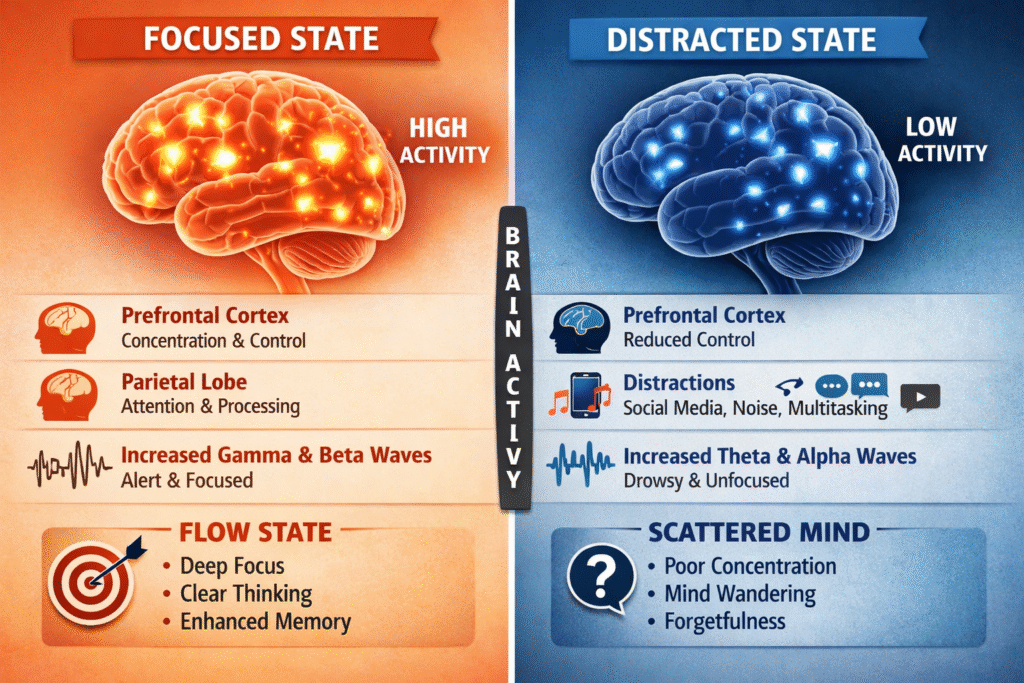
Focus, or concentration, isn’t just about staring intently at something. True focus is your brain’s ability to direct and sustain attention on a chosen task while filtering out irrelevant information. Neuroscientists call this “selective attention,” and it’s one of the most energy-intensive activities your brain performs.
Think of your attention like a spotlight. When it’s focused, that beam illuminates a specific area with clarity and intensity. When you’re distracted, that spotlight starts swiveling rapidly, never settling long enough to see anything clearly. The quality of your work, creativity, and problem-solving all depend on how well you can keep that spotlight steady.
Common Misconceptions About Concentration
The biggest myth about focus is that it’s purely a willpower issue. People think, “I just need to try harder” or “I’m not disciplined enough.” This is fundamentally wrong. Focus isn’t about grinding through with sheer determination; it’s about creating conditions where your brain naturally settles into concentration.
Another misconception is that multitasking helps you get more done. Research consistently shows the opposite. What we call “multitasking” is actually rapid task-switching, and each switch costs you time and mental energy. Studies suggest that it can take 23 minutes to fully refocus after a distraction. Those quick email checks are more expensive than you think.
Many people also believe that distractions are the main enemy, but internal distractions (worry, hunger, fatigue) are often more disruptive than external ones. You can close all the tabs you want, but if your mind is anxious about tomorrow’s meeting, you’re still not focused.
Why Focus Matters More Than Ever
In an economy increasingly based on knowledge work and creativity, your ability to stay focused directly correlates with your professional value. Deep work, as author Cal Newport calls it, produces higher quality output in less time. When you can achieve flow states regularly, you’ll accomplish in three focused hours what might take others eight distracted ones.
Beyond career benefits, focus affects your relationships, learning ability, and mental health. Constant distraction creates a background hum of anxiety and leaves you feeling depleted without having accomplished anything meaningful. When you master concentration, you experience more satisfaction, less stress, and genuine engagement with whatever you’re doing.
2: Prerequisites and What You Need
The Right Mindset
Before implementing any focus tips, you need to accept that this is a skill you’re building, not a switch you flip. Just like learning an instrument or a sport, you’ll have good days and frustrating ones. Progress isn’t linear. Some days you’ll hit flow for hours; other days, fifteen minutes of concentration will feel like a victory. Both are part of the process.
You also need to let go of perfectionism. Waiting for the “perfect” distraction-free environment means you’ll never start. Real focus happens in imperfect conditions. Your goal is progress, not perfection.
Finally, understand that focus is finite. Your attention is a depletable resource that needs recovery time. Planning for focused work means also planning for genuine rest and rejuvenation.
Essential Tools and Resources
You don’t need expensive apps or gadgets to stay focused, but a few tools help. At minimum, you’ll want a reliable timer (your phone works, though a physical one removes temptation), a notebook for capturing intrusive thoughts, and a comfortable workspace with adequate lighting.
Digital tools that support focus include website blockers (Freedom, Cold Turkey, or browser extensions), time-tracking apps (Toggl, RescueTime), and ambient sound generators if you work in noisy environments. These aren’t mandatory, but they reduce friction.
Most importantly, you need a clear understanding of what you’re focusing on. Vague goals like “work on project” don’t cut it. Specific tasks like “write introduction section” or “analyze Q3 data” give your brain a concrete target.
Time Commitment
Building strong focus habits takes about 30 days of consistent practice to feel natural. Initially, you might start with focus sessions as short as 15-20 minutes if your attention span is severely compromised. Within a few weeks, you should reach 45-90 minute focused work blocks.
For daily implementation, expect to invest 10-15 minutes in setup and planning, plus your actual focused work time. The planning time isn’t extra; it actually saves time by preventing aimless work.
Visual Learning for Faster Progress: If you’re a visual learner, watching an expert break down these focus techniques can accelerate your progress. Platforms like Skillshare offer incredible masterclasses, such as “Productivity Masterclass” by Thomas Frank, which deep dives into building systems that defeat distractions. [Join Skillshare and start your focus journey for free today.]
3: The Step-by-Step Method to Stay Focused
Step 1: Conduct a Distraction Audit
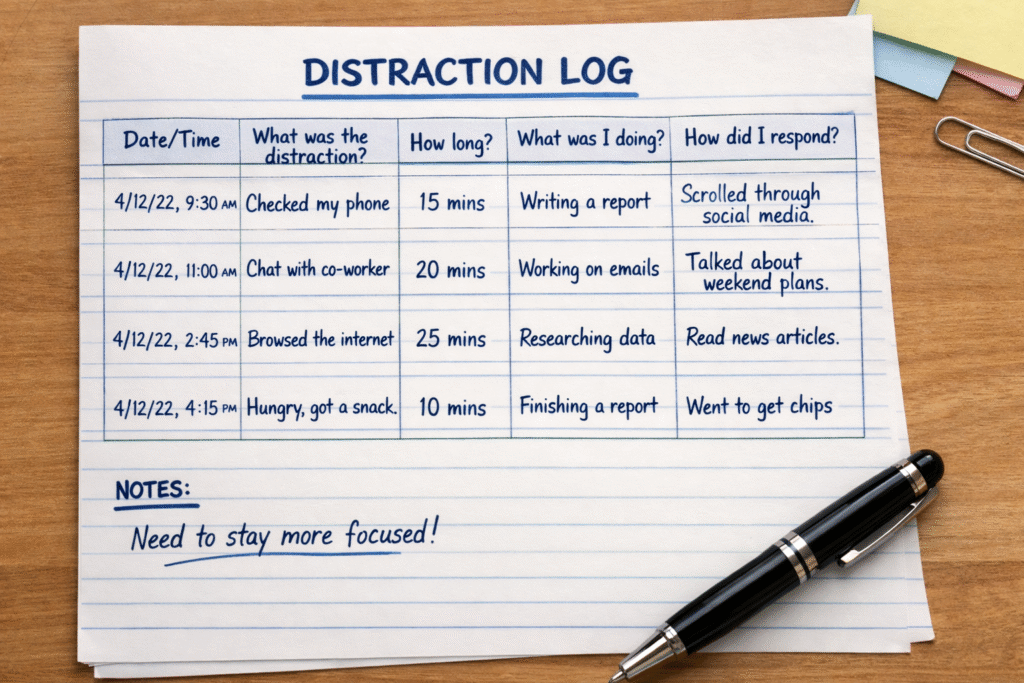
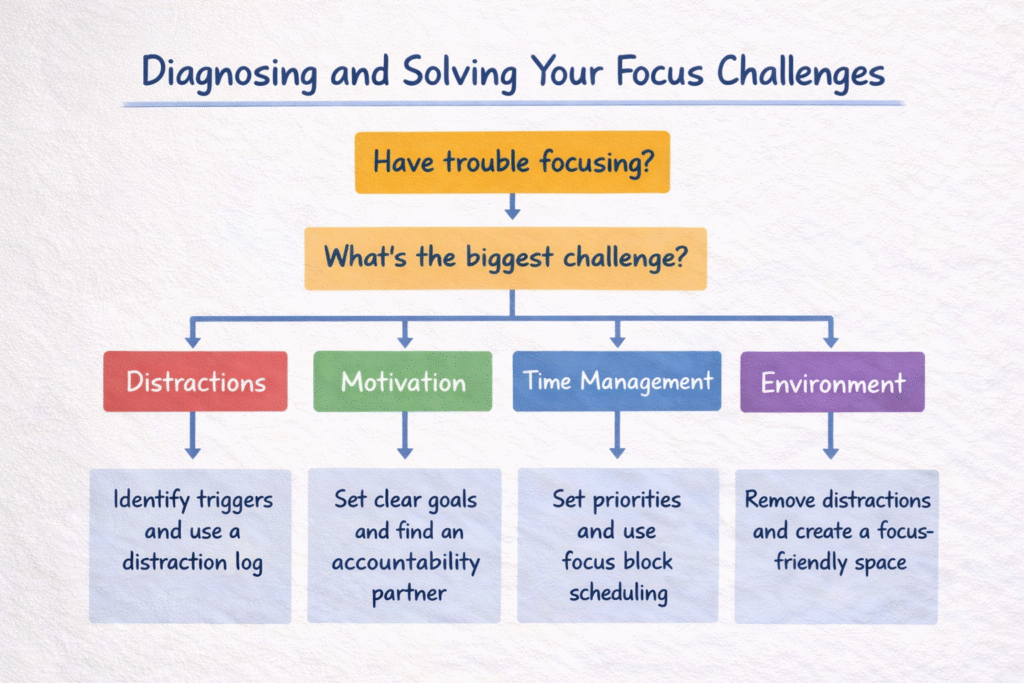
Before you can stay focused, you need to identify exactly what’s pulling your attention away. For the next three days, keep a “distraction log.” Every time you get distracted, jot down what interrupted you, when it happened, and how long you stayed distracted.
You’ll likely discover patterns. Maybe social media pulls you in between 2-3 PM when your energy dips. Perhaps email notifications fragment your morning focus. Some people find their biggest distraction isn’t digital at all—it’s a cluttered desk or uncomfortable chair.
Action items:
- Download a simple distraction tracking template or create one
- Set a phone reminder to check your log every 2 hours
- At the end of three days, categorize distractions: digital, environmental, internal
Pro tip: Don’t try to resist distractions during the audit. Just observe. You’re gathering data, not fighting battles yet.
Example: Maria, a graphic designer, discovered through her audit that she checked Instagram 23 times daily, mostly triggered by receiving text messages. The texts weren’t the problem; they primed her hand to pick up the phone, and Instagram was muscle memory. Knowing this pattern let her create a targeted solution.
Step 2: Design Your Focus Environment
Your physical and digital environment dramatically impacts your ability to concentrate. This step is about architecting spaces that default to focus rather than requiring constant willpower.
Start with your physical workspace. Clear everything off your desk except what’s needed for your immediate task. Research shows that visual clutter competes for attention. If you can, position your desk to face a blank wall or window with nature views rather than toward doorways or high-traffic areas.
Next, tackle your digital environment. Uninstall social media apps from your phone (you can still access them via browser, but the friction helps). Turn off all non-essential notifications. Create separate browser profiles: one for work with only necessary tabs and extensions, one for personal browsing. Use website blockers to make distracting sites inaccessible during focus hours.
Action items:
- Physically clean your workspace completely
- Remove/disable smartphone apps you identified as distracting
- Set phone to “Do Not Disturb” as the default, with only critical contacts breaking through
- Create a “focus playlist” of instrumental music or ambient sound
Common mistake: Going too extreme and creating an ascetic environment that feels punishing. Your space should feel good, not like a punishment chamber. Some personal items are fine.
Scenario: Tech consultant James created two computer accounts on his laptop: “Work James” with blocked social media and only professional software visible, and “Personal James” for evenings. The act of switching accounts created a mental boundary that dramatically improved his concentration.
Step 3: Master the Focus Block Technique
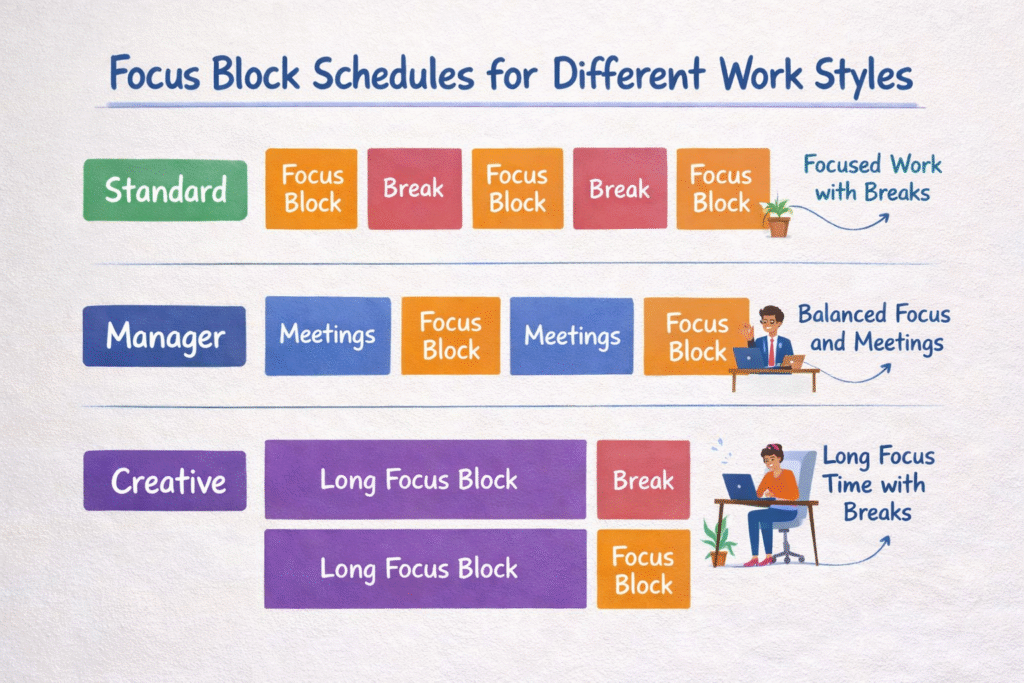
Time blocking is powerful, but focus blocks take it further. A focus block is a protected period where you work on one specific task with full attention. Here’s how to structure them:
Choose your block length based on your current capacity. Beginners might start with 25-minute sessions (similar to Pomodoro). Intermediate practitioners often work in 50-minute blocks with 10-minute breaks. Advanced focus workers can sustain 90-minute blocks aligned with ultradian rhythms.
Before each focus block, write down exactly what you’ll accomplish. Not “work on presentation”—instead, “complete slides 5-8 of Q4 presentation.” Specificity is crucial. Your brain needs a clear target.
Action items:
- Block out 2-3 focus sessions in tomorrow’s calendar
- Write specific outcomes for each block
- Communicate boundaries to colleagues/family (use door signs, calendar blocks, or direct conversation)
- Set up a “focus ritual”—a 2-minute routine you do before each session
Pro tip: Your first focus block of the day should tackle your most cognitively demanding work. Willpower and cognitive resources are highest in the morning for most people.
Example ritual: Before each focus block, Priya makes tea, opens her notebook to a fresh page, writes the date and her single objective, sets her timer, and takes three deep breaths. This 90-second ritual signals her brain that focus time is starting.
Step 4: Implement the Two-Minute Rule for Intrusive Thoughts
Even in a perfect environment, your brain will generate distractions from within. You’ll remember you need to email someone or wonder about a fact you want to look up. These mental interruptions are normal, but how you handle them determines whether they derail your focus.
The two-minute rule works like this: when an intrusive thought appears, you have two choices. If it takes less than two minutes and is genuinely urgent, do it immediately. If not, write it in your “capture notebook” and return to your task. The act of writing it down quiets the mental alarm—your brain knows you won’t forget it.
Action items:
- Keep a dedicated notebook or app open during focus blocks for capturing thoughts
- Review your capture notes during breaks, not during focus time
- If anxious thoughts persist, try the “worry appointment” technique: schedule 15 minutes later to think about whatever is bothering you
Common mistake: Bargaining with yourself that “I’ll just quickly check this one thing.” That “quick check” typically turns into 15 minutes of rabbit holes. Trust the capture system.
Scenario: During a focus block, writer Tom suddenly remembered he needed to call his dentist. Instead of breaking focus, he wrote “Call dentist re: appointment” in his notebook. During his break 40 minutes later, he made the call. By then, he’d completed a full article section that would have been fragmented if he’d called immediately.
Step 5: Create Strategic Breaks for Recovery
Focus isn’t about grinding for hours without pause. Your attention is a muscle that needs rest. Strategic breaks actually enhance your ability to stay focused by preventing mental fatigue and decision fatigue.
Effective breaks have three characteristics: they’re planned (not spontaneous), they’re genuinely restorative (not just different work), and they’re time-bound. A good break might be a 5-minute walk, stretching, meditation, or a genuine social conversation. Bad breaks involve scrolling social media or reading news—these don’t restore attention.
The Pomodoro Technique suggests 5-minute breaks after 25-minute sessions, with a longer 15-30 minute break after four sessions. If you work in 90-minute blocks, take 15-20 minute breaks. During longer breaks, physically leave your workspace if possible.
Action items:
- Schedule breaks with the same rigor as focus blocks
- Create a break menu: 5-10 activities you find genuinely refreshing
- Set a timer for breaks too (they should end just as deliberately as they start)
- Use breaks to address physical needs: hydration, movement, hunger
Pro tip: The best breaks involve movement and nature. Even walking to a window and looking at trees for two minutes provides measurable attention restoration.
Example: Software developer Aisha sets a 90-minute timer for deep coding work. When it rings, she walks outside for exactly 15 minutes, regardless of weather. She returns mentally reset, often with solutions to problems she’d been stuck on. The consistency of this rhythm has made her twice as productive.
Step 6: Anchor Focus to Your Energy Rhythms
Everyone has a chronotype—a natural pattern of energy and alertness throughout the day. Fighting your biology is exhausting. Instead, schedule your focus work when your body is naturally primed for concentration.
Track your energy levels for a week. Rate your alertness, motivation, and mental clarity every two hours on a scale of 1-10. You’ll discover your peak performance windows. For many people, this is 9-11 AM and 3-5 PM, but you might be completely different.
Once you know your rhythms, protect your peak hours ferociously for your most demanding focus work. Use lower-energy times for meetings, administrative tasks, and planning. This alignment multiplies your effectiveness.
Action items:
- Complete a one-week energy audit (template available)
- Reorganize your calendar to match focus work to energy peaks
- Communicate your focus hours to colleagues (many will respect them)
- Experiment with when you consume caffeine to support, not override, your natural rhythms
Common mistake: Trying to force focus during your natural energy valleys. You’ll exhaust yourself and build negative associations with focused work.
Scenario: Marcus discovered he’s a night owl forced into a morning world. Instead of fighting it, he scheduled all his meetings for mornings (when he’d struggle with focus work anyway) and reserved 7-10 PM for his most creative work. His output improved dramatically, and he stopped feeling like he was constantly swimming upstream.
Step 7: Use Implementation Intentions to Automate Focus
An implementation intention is a specific plan that links a situation to an action: “When X happens, I will do Y.” These “if-then” plans bypass the need for in-the-moment willpower by automating your response to common distraction triggers.
Review your distraction audit from Step 1. For each common trigger, create an implementation intention. For example: “When I feel the urge to check my phone during focus time, I will write the reason in my capture notebook instead.” Or: “When I finish a task before my focus block ends, I will immediately start the next predetermined task rather than taking an unplanned break.”
Action items:
- Write 3-5 implementation intentions addressing your most common distraction triggers
- Post them visibly where you work
- Review and refine them weekly
- Share them with an accountability partner
Pro tip: Make your intentions specific about both the trigger and the response. “I’ll focus better” is too vague. “When a notification appears during focus time, I will glance at it to ensure it’s not an emergency, then immediately return to my task without reading it fully” is actionable.
Example: Designer Lisa struggled with mid-afternoon energy crashes that led to social media binges. Her implementation intention: “When I feel my energy dropping after 2 PM, I will take a 10-minute walk with a podcast instead of opening Instagram.” This specific plan created a new pathway, breaking the old trigger-response pattern.
Step 8: Practice Single-Tasking Deliberately
Multitasking feels productive but destroys the quality of focus. Single-tasking is the antidote, but it requires deliberate practice because our brains are now wired for constant stimulation.
Start with the “one browser tab rule”: only one tab open at a time for five focus blocks. It will feel uncomfortable. That discomfort is your brain adjusting. After mastering one tab, expand to one application at a time. Eventually, you can hold a single task in mind for an entire focus block without even the temptation to switch.
Action items:
- Close all applications except the one you need for your current task
- Put phone in another room (not just face-down on desk)
- If you must have reference materials open, use a second monitor or printed documents
- Practice “completion consciousness”: finish what you start before moving on
Common mistake: Confusing single-tasking with inflexibility. If you discover you’re working on the wrong thing, it’s okay to stop and switch deliberately. Single-tasking means no mindless switching, not no switching ever.
Scenario: Project manager David noticed he had 43 browser tabs open while trying to finish a report. He closed all but the report document and one reference tab. His writing speed doubled, and the quality improved. The other tabs represented unfinished thoughts fragmenting his attention.
Step 9: Build Focus Accountability
External accountability dramatically improves follow-through. When you know someone will ask about your progress, you’re more likely to stay focused and complete what you set out to do.
Find a focus partner—someone also working on improving concentration. Schedule brief daily or weekly check-ins where you share what you’ll focus on and report back on how it went. The simple act of articulation makes goals more concrete, and knowing you’ll report back adds positive pressure.
Action items:
- Find one person to be your focus accountability partner
- Set a recurring check-in time (even 5 minutes works)
- Use body doubling: work simultaneously with someone else via video call or in person
- Join or create a focus group where members share techniques and progress
Pro tip: Accountability works best when it’s supportive, not judgmental. Frame check-ins as “What worked and what didn’t?” rather than success/failure.
Example: Writers Sarah and Tom set up “focus hours” where they video call with cameras on but microphones muted, working in parallel. The presence of another person working creates social pressure to stay on task. They each report completing 40% more during these sessions than when working alone.
Step 10: Track and Celebrate Progress
What gets measured gets improved. Tracking your focus not only shows progress but also helps you identify what’s working. Use whatever system feels natural: a simple tally of focus blocks completed, a time-tracking app, or a focus journal.
Record three things daily: how many focus blocks you completed, what you accomplished in them, and how the quality of focus felt. Over time, you’ll see patterns: certain days, times, or task types where focus comes more easily.
Crucially, celebrate small wins. Completed a 25-minute focus block without checking your phone? That’s worth acknowledging. Finished a deep work session a week? Take time to recognize it. Progress compounds when you notice and appreciate it.
Action items:
- Choose one tracking method and commit to it for 30 days
- Set weekly review appointments with yourself to assess trends
- Create a visual tracker (habit tracker, chart, calendar) where you can see progress
- Define milestones and rewards (after 20 focus blocks, treat yourself to something meaningful)
Common mistake: Comparing yourself to others. Someone else might naturally sustain three-hour focus sessions while you’re building up from 20 minutes. Your only competition is yesterday’s version of yourself.
Scenario: Entrepreneur Jasmine used a simple wall calendar to mark each day she completed at least three focus blocks with a green dot. After two months, the wall of green dots became self-reinforcing motivation. She didn’t want to break the streak, and seeing her progress made the practice feel sustainable rather than difficult.
Section 4: Troubleshooting Common Focus Obstacles
“I can’t focus because my mind races with anxiety”
Anxiety is one of the most challenging internal distractions. When your mind is generating worried thoughts, standard focus tips feel useless. The solution isn’t to suppress anxiety but to create a container for it.
Before focus blocks, spend five minutes doing a “brain dump”: write every worry, task, and concern currently in your mind onto paper. This externalizes the mental clutter. Then, consciously set it aside with a promise to yourself that you’ll address these concerns during your scheduled worry time (perhaps during a break or end-of-day).
If anxiety intrudes during focus time, use the RAIN technique: Recognize the anxious thought, Allow it to be there without fighting it, Investigate it with curiosity (what am I worried about?), and Non-identify (I’m having an anxious thought, but I am not my anxiety). Then return to your task.
For persistent anxiety that interferes with focus regularly, consider working with a therapist. Anxiety disorders are treatable, and addressing them can dramatically improve your capacity to concentrate.
“Notifications and messages derail me constantly”
This is the most common obstacle, and the solution is more radical than most people implement. The key is accepting that true focus requires being temporarily unreachable.
Set clear communication boundaries: establish specific times when you’re responsive (perhaps 11 AM, 2 PM, and 4 PM for checking messages) and communicate these to colleagues and clients. Use auto-responders that set expectations: “I check email twice daily to allow for focused work. For emergencies, call my phone.”
For those who worry about true emergencies, whitelist only essential contacts who can break through Do Not Disturb mode. Real emergencies are rarer than we imagine.
“I start focused but fade after 20 minutes”
This indicates your focus endurance needs building, which is completely normal if you’ve been living in a distracted state. The solution is progressive training, just like building physical endurance.
Start where you are. If 20 minutes is your limit, work in 20-minute blocks with 5-minute breaks. Each week, add just 5 minutes to your focus blocks. Within two months, you’ll reach 60-minute sessions. Don’t rush this progression—your brain needs time to adapt.
Also assess basics: are you properly hydrated, fed, and rested? Focus requires energy. Skipping meals, chronic dehydration, or sleep deprivation will cap your focus capacity regardless of technique.
“My work requires constant collaboration and interruptions”
Some jobs genuinely require high responsiveness, but most knowledge workers overestimate how available they need to be. Even in collaborative environments, you can negotiate focus time.
Communicate your focus blocks to your team: “I’m doing deep work from 9-11 AM and will respond to messages after that unless it’s urgent.” In open offices, use headphones and visual signals (closed laptop, back to common areas) to indicate you’re in focus mode.
Batch your collaborative time. Instead of scattered 15-minute meetings throughout the day, try to cluster them. Having three consecutive meetings is less disruptive to focus than the same three meetings spread across the day with fragmented work time between them.
“I get bored and crave stimulation”
If you find focused work boring compared to the dopamine hits of social media and notifications, your brain’s reward system may have been hijacked by digital stimulation. This is fixable but requires a deliberate reset.
Consider a “dopamine detox”: for one to seven days, eliminate high-stimulation activities (social media, YouTube, video games, news scrolling). This allows your baseline dopamine to recalibrate. Afterward, focused work will feel more engaging because your brain isn’t comparing it to hyperstimulating alternatives.
Additionally, ensure the work you’re focusing on connects to genuine goals and values. Boredom often signals misalignment. If everything feels boring, the issue might not be focus but direction.
5: Advanced Focus Strategies
Once you’ve mastered the fundamentals and can sustain focus for 60-90 minutes consistently, these advanced strategies can take your concentration to the next level.
Time-boxing with constraints: Rather than open-ended work sessions, set aggressive time constraints. Tell yourself you’ll complete a task in half the time you think it needs. This creates productive pressure that actually enhances focus by engaging your brain’s challenge response. The mild stress of a deadline, when self-imposed and not panic-inducing, sharpens attention.
Focus stacking: Chain multiple short, intense focus sessions back-to-back with brief breaks between. For example, three 45-minute blocks with 10-minute breaks can generate momentum where each subsequent session feels easier than the last. The key is keeping breaks genuinely restorative so you’re not just accumulating fatigue.
Environmental rotation: While a consistent focus environment helps most people, some advanced practitioners benefit from rotating between locations. Working on different tasks in different spaces creates contextual cues that prime specific types of focus. Writing in a café, analyzing data in a library, creating in your home office—each location can become associated with different work modes.
Pre-commitment devices: Use tools that raise the stakes of distraction. Apps like Forest or StickK allow you to commit money or social reputation to staying focused. The potential loss creates an extra barrier to distraction. Use these sparingly as a motivation boost, not as your primary system.
Mindfulness meditation practice: A formal meditation practice, even 10 minutes daily, trains the exact neural circuits that support focus. Meditation is essentially focus practice in its purest form. After several months of consistent meditation, most practitioners notice substantially improved concentration across all domains.
Strategic incompletion: Counterintuitively, stopping work mid-task rather than at natural completion points can improve your ability to stay focused when you return. The Zeigarnik effect describes how unfinished tasks remain active in our minds, making it easier to dive back in. Try ending your work day in the middle of a sentence or problem you’re working on.
Link to article about “How to Overcome Yourself in Difficult Times: The Power of Self-Discipline
How to Overcome Yourself in Difficult Times: The Power of Self-Discipline
Conclusion
Learning how to stay focused in our distracted world isn’t about willpower or discipline alone. It’s about understanding how attention works and creating systems that support concentration rather than fighting against constant distraction.
We’ve covered the complete framework: from auditing your distractions and designing your environment to mastering focus blocks, managing internal distractions, aligning with your energy rhythms, and building sustainable habits through accountability and tracking. Each step builds on the previous ones, creating a comprehensive system that makes deep focus your default rather than a constant struggle.
The most important thing to remember is that focus is a skill you develop through practice, not a trait you either have or don’t. Every focused minute you complete strengthens your capacity for the next one. Progress won’t be linear—some days will feel harder than others—but consistency matters more than perfection.
Your first step is simple: complete just one 25-minute focus block today. Choose a specific task, eliminate distractions, set a timer, and give that one thing your complete attention. Don’t worry about making it perfect or sustaining it for hours. Just prove to yourself that 25 minutes of real focus is possible.
From that single session, build momentum. Add another focus block tomorrow. Track your progress. Adjust based on what you learn about your attention. Within weeks, you’ll find that the chaotic, scattered state that once felt normal has been replaced with a capacity for deep work that transforms both the quality of your output and the satisfaction you feel in your daily life.
Focus is the superpower of the 21st century. You now have the complete system to develop it. The only question is: will you start today?